
- Dialogue
- Abstract
- Author
- Downloadable PDF
- Introduction
- Defining Trans Information Work
- Working Through Trans Information In Libraries
- Encountering Historical Trans Information Work
- Re/Learning Trans Information Work
- Acknowledgments
- References
Dialogue
Want to learn more about the piece and the ideas explored in it? Enjoy our in-depth conversation with the author.
Abstract
This article explores the concept of trans information work within the broader context of library and information science. The article deploys both research related to information practices and a critical examination of the material and affective labor that trans information workers are asked to do within and outside their work. Through reflective anecdotes of the author’s own trans information work and their encounters with archival evidence of past trans information work, the article envisions a reparative and hopeful version of the inextricable connections between trans folks in the past and trans folks in the future. The article shares definitions of trans information work, considers approaches to trans information work within a library setting, and offers advice on how to ensure that the burden of trans information work does not fall upon trans communities. The article seeks to reframe the labor of trans information work towards a more collective and collaborative endeavor that helps protect trans communities in the present, while ensuring evidence of trans existence remains accessible now and in the future.
Author
Travis L. Wagner (they/them) is an assistant professor in the School of Information Sciences at the University of Illinois Urbana-Champaign. Wagner’s research interests include critical information studies, digital curation, and queer archives. Their work investigates how LGBTQIA+ communities create identity in opposition to sociotechnical systems that characterize and limit those identities. Their recent publications include articles in the Journal of Information Science, Archivaria, and the Journal of Documentation.
Downloadable PDF
Introduction
I can imagine that every trans or nonbinary person who has either made their identity known or has explicitly worked to advance the acceptance of trans folks has experienced a story similar to the one I am about to describe.
I am preparing to head to work when a message pops up in my notifications on a certain social media platform. It is from someone who occasionally messages me to congratulate me on my career advances but from whom I had otherwise not heard from in nearly four years. Paraphrasing his request, he wanted to ask me about the implications of allowing children to transition, specifically what it would mean for unfair advantages in girls’ sports. As he explained in the message, he insisted on messaging me to gather my “opinion” rather than posting the question on his own social media account and being subjected to “groupthink” on the topic. The affordances of this particular social media platform allowed me to see the entire message without leaving him on read.
I thought more throughout the day about why this person insisted on reaching out to me and asking this question. Rather than fixating on how to respond, I wondered what had led him to this particular choice of seeking my opinion as a form of information. He had, in the past, shown a reliable willingness to access trusted and verified information online across a varied set of politically hostile topics in a self-directed fashion. Further, he never shied away from introducing this information to his public account, even if the results opened the topic up to debate with others. However, the question of allowing trans youth into sports caused him to take a different approach, one that relied on a more private conversation with someone who he knew had openly talked about trans topics in the past. Much as librarians are tasked with being trusted facilitators of information, I imagined he wanted my expertise, but it was unclear if my expertise was as a scholar or as a trans person.
I now had a new set of questions running through my mind. He has grandchildren, and perhaps some of them are playing sports. Is he hearing these concerns from them, the other parents and grandparents of these children, or is this truly his way of making sense of talking points circulating across a variety of politicized news channels and pseudo-informational websites? Does he see the question of when to support transition through things like hormone replacement therapy and puberty blockers as something without a consensus in objective science (thus warranting my opinion)? Does he simply want to know what it means to socially support a young trans person in a moment where hostility was at an all-time high? Does he see me as a trusted resource for information on trans identities and, if so, is it because he knows and accepts me as a trans person?
This last question led me to be particularly reflective, because it forced me to think about my own positionality as an academic and as a person who identifies within the broad umbrella of trans and non-binary. Again, he knew me as an academic, but I had never disclosed my gender identity in a formal way to this person. Like many queer folks, my coming out was non-linear, inelegantly enacted across friend groups and colleagues, and for many people in my past, has been identified through my pronoun disclosure on social media platforms or my positionality statements in articles. As such, the person asking me this question could be either seeking my thoughts as someone who studies the relationship between trans and queer folks and information, or my opinion as a trans person. I didn’t know the intention then, and, honestly, I still don’t know the intention today. That said, I did answer later that day in emphatic affirmation that I believed that a person, regardless of age, should be allowed to play on the team with which their own gender identity aligns. Moments later, I was asked by this person to then address a critique that trans women might have unfair advantages in sports based on biology. A biological essentialism dog whistle to be sure, but I remained unclear if this was something he believed, or if he was asking on behalf or in the hopes of educating others. Rather than mount evidence that I am sure he could have found for himself, I merely replied that most of those assertions of unfair advantages were hypothetical and lacked grounding in real-world experience and reminded him that any attempt to define normative identity through genetics and biology had roots in scientific practice that is now generally disowned, such as phrenology (Wolfe & Paterson, 2026). This person then asked how I felt about trans men playing sports. Accepting now that the questions might be coming from a less earnest place, I said that my response to this question matched what had been stated earlier and that I had nothing else to contribute. He never responded.
I am not offering this anecdote for sympathy; it is a common experience. Rather, I offer it because it encapsulates some important aspects of trans information work and what it means to do trans information work in this historical moment when trans narratives and counternarratives are once again under attack. Simply put, it is a trying time to be doing trans information work. In response, this paper seeks to explore and define trans information work. To do this definitional work, this paper explores the material and affective labor associated with trans information work and places examples of trans information work in the setting of librarianship. The placement of discussions within libraries, while not the sole location of trans information work, matters. Libraries are a place where both formally and informally trained information professionals already engage in this work, yet, as I will argue, trans information work often exists within communal rather than institutionalized forms of praxis. The paper further identifies approaches to trans information work as informed by ideas of information practices and trans technologies and concludes by reflecting on what it means to discover serendipitous trans information work in archival encounters. The discussed encounter serves as speculative conclusion to explore the future of trans information work in a time when such work is particularly exhausting and difficult.
Defining Trans Information Work
The provision of information and the act of obtaining new information necessitate exchange between a person and an institutionally-approved intermediary. In this sense, information flows through libraries, schools, hospitals, and other similar spaces. The rise of distributed social networks and participatory culture afforded new modes of information to emerge and continued to enable individuals to produce information across modalities at ever-expanding rates (Jenkins, 2006; Gleick, 2011). It is in this sociohistorical moment that trans information work finds its roots. Trans information work is the sharing and communicating of information by, about, and for trans individuals that affirms their existence and makes visible trans ways of being. Further, and perhaps more critically, trans information work combats the circulation and distribution of anti-trans information by refuting it and, when necessary, creating new information vetted by and through trans communities. To be clear, trans information has likely always existed, however, in the wake of advances in participatory communication networks, the verisimilitude of information seemed to decrease rather than increase. Both producers and consumers of information now face persistent questions about mis-, dis-, and malinformation (Broda & Strömbäck, 2024). As an inelegant, but quick primer on the distinctions between the three types of information: Misinformation is that information which, regardless of intention, is incorrect, outdated, or misleading. Disinformation is that which seeks to deceive and often erode otherwise viable information ecosystems. Finally, and perhaps most prescient to current trans realities, is malinformation, the repurposing of facts to invert and falsify information with the intent of harming. An inclination to blame technologies for facilitating these informational integrity issues, while part of the equation, fails to address the systemic and affective underpinnings of antagonistic information creation and circulation. Take, for example, the continued rise of deepfake technology, which threatens the authenticity of visual information. Critical information studies scholars, myself included, have advocated for preventing the distribution of these technologies by examining how their creation stems from sexist and exploitative objectification, rather than by proposing corrective backend tools to evaluate their design (Wagner & Blewer, 2019; Dan et al., 2021). In other words, the products of affectively charged information, especially information that seeks to delegitimize and exploit marginalized groups, lay bare their emotional intentions under scrutiny. Even the circulation of transphobic (or at least trans paranoid) misinformation, when interrogated, often reveals the anxieties of the creator and circulator’s close personal circles.
In response to these troubling paradigms of information misuse and the reality that it is inarguably infused with antagonism towards trans individuals, it is critical to understand trans information work, then, as an affective and often embodied response to trans exclusionary information. Here, trans exclusionary information is best understood as that information which excludes trans people in its configuration (i.e., misinformation) and that information about trans people which seeks to delegitimize or even erase them from existence (i.e., disinformation and malinformation). Beyond producing affirming information, trans information work is explicitly about combating exclusionary information systems and involves creating individual- and community-vetted resources to ensure access to timely healthcare and legal information (Kitzie et al., 2022; Wagner et al., 2022). At other times, trans information work is about the speculative and imaginative possibilities of media creation through which transgender ways of being become formalized (Fink & Miller, 2014; Floegel & Costello, 2021).
A discussion on the rise of technology in facilitating the mediation and remediation of information offers a necessary reminder that where trans information work happens, so, too, trans technologies take shape. In his recent eponymous work on trans technologies, Oliver Haimson (2025) deftly defines a technology as being trans when it fulfills one of two functions: First, and more practically, a trans technology is that which “addresses trans people’s needs and is made, by, for, and/or centering trans people.” Second, and here of equal importance, a trans technology “opens up new possibilities for what it can do by foregrounding change and transition” (p. 35). To put a finer point on Haimson’s book as it relates to the idea of trans information work: like a trans technology, trans information work should address the material information needs of trans folks and, if possible, open up new information worlds for the folks being provided with this information. Put another way, we are able to have an ecosystem of trans information work, because there now exist locatable and utilizable trans technologies which foster the creation and facilitation of, amongst other things, trans information. Technological infrastructures offer the possibility to both perpetuate and destabilize cisnormative worldviews (Spiel, 2021). Contending with this reality, how might libraries facilitate information work and serve as a form of technology and, further, what would it mean to place transness central to either endeavor?
Working Through Trans Information In Libraries
Questioning whether or not libraries are a technology is beyond the scope of this article, but libraries certainly include information in the form of technological mediation. Libraries, through their infrastructural design, serve as interlocutors for information technologies. One can see the reference desk as an information technology. Equally, the books on the shelves and how they arrive upon those shelves are evidence of both visible and invisible technological interventions (Mattern, 2014). Libraries can, of course, be spaces of liberatory possibility; as Radford et al. (2015) remind us, they exist as heterotopias whose ability to reflect, refract, and even rupture representative possibilities possesses a cultural reference point beyond the purely informational. Queer culture has even canonized the liberatory possibility of identity discovery in libraries. For example, in her graphic memoir Fun Home, Alison Bechdel (2006) reveals that she learned the taxonomy of queerness through a library card catalog and thus sought informational refuge in libraries and library-like spaces (Simon, 2016). However, these experiences with the library as a liberatory space are hardly universal to queer populations and prove chronically challenging for transgender and nonbinary individuals. In particular, attempts to make libraries more trans inclusive through signage and accessible bathrooms provide palliative care to more systemic issues, such as shelving trans physical resources alongside works on deviance, misgendering authors in digital resources, and, generally, providing outdated information resources in library guides (Wagner & Crowley, 2020). In their literature review of trans-related issues within librarianship broadly conceived, Keahi Adolpho and Stephen Krueger (2024) suggest this is a broader problem of cisnormativity within the profession and the tools utilized by information systems, and, in doing so, advocate for a de-cisifying of the profession.
For trans library workers, labor also reflects institutional priorities. Deploying Dean Spade’s (2015) theory of administrative violence, Magnus Berg (2025) contends that trans and gender diverse librarians are often asked to do disproportionate amounts of labor relative to their cisgender colleagues, often further burdened with doing interpersonal and emotional work to assuage their colleagues’ transphobia or trans paranoia. Berg’s evocation of Spade is particularly generative, as Spade, who is a trans legal scholar, frames administrative violence as a method to think through the disjointed relationship between the cultural acceptance of trans communities and the policies enacted to protect the rights of trans populations more broadly. As such, the politics of making one’s self visible reinforce the normative expectations of a cisnormative society, which, at best, requires trans individuals to justify and explain their and other trans individuals’ existence. At worst, it invites trans people to become targets of antagonism without the promise of protection from such vitriol. Trans librarians and information professionals often do more unpaid and undervalued labor than their cisgender peers, who are arguably equally equipped to find and evaluate the information they are asked to gather. Indeed, in anecdotal discussions with the editors of this journal, a part of illuminating this particular tension came from sharing similar stories of often being asked to gather information about trans subjects simply due to being trans, when such work undeniably fell under the purview of their colleagues’ job descriptions. A paradox emerges from these tensions: no person is better equipped to do trans information work than a trans individual, yet in the context of librarianship, this specific type of information work is often done without economic or material supports and, further, becomes an affective obligation not extended to cisgender colleagues. Put more bluntly, trans information professionals become not just unwilling subject experts on their lived experiences, but the interlocutors of all trans experiences, even when information on those experiences are readily available and accessible to any person.
As Jennifer Brown, nicholae cline, and Marisa Méndez-Brady (2021) observe, there exists a disproportionate amount of labor placed on Black, Indigenous, and People of Color (BIPOC) information professionals. By using academic library positions as their site of analysis, they reveal that BIPOC librarians are often commodified into diversity representatives who are tasked with the difficult and thankless work of insisting on representation, while their white colleagues’ mere affirmation of its need serves as an imagined comparable level of labor. To this end, the authors critique the lack of material supports to such work, ranging from less pay to an inability to reconcile the time and effort of diversity work into evaluation mechanisms for promotion. It is paramount to state here that I and many other scholars and practitioners working and thinking about work in libraries are indebted to the late Fobazi Ettarh (2018) and her conceptualization of vocational awe. As a profession, Ettarh contends, librarianship prides itself on service, which facilitates access to information, producing a sense of an inherent goodness. In turn, since the professional is glamorized as doing social good, this labor becomes subject to exploitation through overwork, low pay, and the incessant issue of mission creep. Returning to the emotional stakes of trans information work, the often-unspoken expectation that trans information professionals be accountable to all types of trans information and, particularly, published, verified, and publicly available trans information, can manifest in a form of vocational awe. Cisgender information professionals can and do expect trans information professionals to do their job out of a sense of social obligation, even when that work is ostensibly a task akin to simple reference work. While distinct between types of information professionals, Ettarh’s broader concerns about susceptibility to vocational awe prove true for public librarianship, academic librarianship, and archival work, just to name a few. Inherent in Ettarh’s work and this critique of vocational awe more broadly are the disproportionate ways that labor falls on people in marginalized positions.
When unexamined, library work runs the risk of normalizing the exclusion of transgender identities and cultures. Change can be brought about through methodical alterations to structures that prop up exclusion. By engaging in trans information work, libraries and information spaces can rupture these cisnormative biases. A clear example of trans information work comes by way of the Transgender Metadata Collective, who sought means to incorporate queer inclusive metadata schemas into libraries and archives and built a set of ethical guidelines to approach the cataloging and description of transgender-related materials within libraries and archives (Watson et al., 2023).
Trans information work thus becomes about differentiating between the often-cyclical work of redressing infrastructure failures and the more immediate demands of combating trans exclusionary and anti-trans information. Here, trans information work differentiates between iteratively correcting something like an outdated subject heading and denoting the misinformation circulated in books by transphobic authors. In response, trans individuals may take it upon themselves to intervene and remediate the same resources that redress issues of misrepresentation within libraries, for example, through creating spreadsheets of library resources using contemporary trans terminology, correcting author pronouns, and providing content warnings about potentially disconcerting topics (Weiser et al., 2018). To be clear, this work ought not to be done only by trans folks and trans library workers alone, but anecdotally speaking, it is rarely led by cis folks in isolation. To redress this failure, cis librarians and information workers can and should take it upon themselves to learn how to be effective trans allies and, in particular, effective at facilitating trans information work. For example, trans information work could involve volunteering to undertake collection audits for known transphobic information and work on its removal, thus freeing up time to focus on other trans information work, such as creating and curating new, affirming trans information resources. Information activism takes the form of organizational remediation and helps ensure efficient and affirmative engagements with trans library resources. Echoing Stephen Krueger’s (2019) discussion of designing trans inclusive libraries, “the more people who participate in gender inclusion work, the easier it becomes for the people doing it as well as those affected by it” (p. 16).
There is an inarguable value in ensuring that those most directly impacted by trans information are given agency to define, curate, and circulate it. Explicitly, trans information work includes defining trans identity itself and how and through what mechanism those definitions emerge. While trans information practices extend beyond questions of health and well-being, queer health information practices prove instructive here. As Kitzie et al. (2022) show, queer communities (including trans individuals) enact both defensive and protective information practices for themselves and their communities. Defensive information practices occur when a known threat to information exists and requires reactive work to mitigate such threats. For trans individuals, these defensive community and individual practices might include the gathering of information resources in anticipation of a barrier emerging. This could, for example, include the active attempts to download and preserve books, scholarly research, and census data about transgender communities removed from government websites and public libraries in the wake of the second Trump administration (Allgood & Wagner, 2025). Further, this might look like transgender archivists and trans-affirmative archival allies over-describing trans possibilities in archival records in the anticipation that it might be otherwise difficult to find such information within cisnormative library and archival repositories (Wagner et al., 2025). Protective communal and individual information practices are in response to perceived risks to queer communities. In the context of trans individuals, this information work would be more reactive to the spread of misinformation and would make use of one’s lived experience and what they have learned from the broader trans community to challenge the dangers associated with misinformation.
In the now-foundational book chapter on queer information work, Emily Drabinski (2008) reminds practitioners that library infrastructure is both necessary and always likely to be limited. In response, Drabinkski proposes a method of “teaching the radical catalog” that invites critique, alteration, and rethinking of one’s relationship to information and its infrastructures. While this work can result in restructuring, Drabinski reminds us that there is equal, if not greater, value in giving people space to ask questions and seek affirmation in those inquiries. Library shelving issues related to transgender identities are one such protective information practice; while it could behoove practitioners to reorganize books on trans and queer topics, it might not be an immediately viable action. By providing some context about a library’s shelving choices, either through a content warning or by guiding trans users through the process of navigating the outdated system, one sees an example of trans-protective information work, especially when done in one’s formal capacity as an information professional. Extending considerations of protective information practices, Megan Threats (2025) reminds us that not all queer information practices are in response to barriers or are acts of resistance and resilience, for these presume a reaction to delegitimizing institutions. By reworking Threats’ ideas of promotive information practices, we can envision trans information that is promotive and even celebratory. It can be equally viable for trans information work to be proactive and information-sharing. For library and information professionals, trans information work can take the form of resource provision through highlighting, when safe to do so, legal, health, and other transitional information. Centering the lived experiences of trans people in this information circulation and remembering that, like trans technologies, this information must work to open up new ways of being for trans folks, these resources should be localized, affirmative, and iteratively built (Krueger, 2019; Haimson, 2025). In other words, the provision of trans information is often merely about suggesting possibilities for others. Serendipitous discovery of trans information is almost always necessitated by the trans information work of other trans folks.
Informational zines about one’s experience transitioning, for example, while deeply personal, circulate to affirm the possibility of going through this experience (Latham & Cooke, 2020). This is both protective and promotive trans information work built by trans communities. Library and information professionals will understand the need for defensive information work, wherein access to institutionalized trans information, at the time of publishing, remains contested. By accessioning and circulating these zines, information is made available in anticipation of a barrier to trans information. Libraries could engage with trans information circulation and creation by having creative sessions with trans media and information objects as reference points. A zine-making workshop could use trans-affirming zines as an example, or a library worker might plan programming in which patrons play a trans-affirming video game, such as Celeste, and then participate in a design session. While this is not an assurance that the digital objects created will themselves be trans narratives, it acknowledges the possibility of transness as a way of being and allows creativity to imagine trans information worlds as already present.
Further, it is important to remember that part of trans information work is the embrace of the speculative and the imaginative; queer world-building and trans identity-making work is often facilitated through creative outlets such as fan fiction and the aforementioned zine creation (Floegel & Costello, 2021). To this end, trans information work can be understood as a form of cultural circulation and co-production. Viewing older trans information artifacts, such as the Cross-Talk newsletter, provides a wonderful example of this cultural circulation as information work. For example, in the November 1994 issue of Cross-Talk, a segment titled “GREAT MOMENTS IN TV HISTORY” locates examples of drag performances in sitcoms such as Night Court and the Phil Silvers Show (Judd, 1994). While these are obviously distinct from representations of trans identity in media that would come in the prior and the following decades, it is clear that there is a legitimizing force to these images. A few pages later in the same issue of Cross-Talk, a multipage report on the 1994 Michigan’s Womyn Festival reflects on the realities of trans women and intersex individuals who were able to successfully join the controversial event, whose ‘womyn born womyn’ entry policy prophesied a key talking point of trans exclusionary radical feminism (Walworth, 1994). Rather than painting this space as a lost cause, the story highlights the acceptance of trans women within a historically exclusionary space, producing a sort of trans-promotive information work that provides readers with a hopeful example of societal acceptance for trans people. The collaborative nature of newsletters like Cross-Talk lets trans information work be about both media documentation and remediation. It was also about parallel acts of trans cultural creation in this case, through the experiences of attending a musical festival.
Encountering Historical Trans Information Work
Even with these optimistic visions of the possibility of trans information work to legitimize trans visibility and to promote, protect, and defend trans individuals and their communities, I cannot help but reflect on the exhaustion and frustration I felt following the anecdote that opens this article. I was hesitant to do trans information work in this case and was frustrated by the interaction’s end goal. But, in classic trans fashion, a serendipitous encounter with a trans archival document changed my feelings. In the same issue of Cross-Talk (#61, November 1994) discussed moments ago, there sat, between an events calendar and a list of North American-based gender exploration hotlines, two printed-out message board posts. Printed via the Prodigy Interactive Personal Service at 6:30 and 6:31 PM on December 5th, 1994, the documents represent posts to a bulletin board system (BBS) on “MEDICAL SUPPORT” and more specifically within the subtopic of “OTHER MEDICAL.” The subject of the post tellingly reads “GENDER ISSUES.”
The two messages, likely part of a larger discussion on this BBS, provide the original poster, Rebecca, with a series of talking points that respond to their mother, who seems to allege that Rebecca being trans is an affront to God. Below is a response from a singular post co-signed by Gloria and Diane:
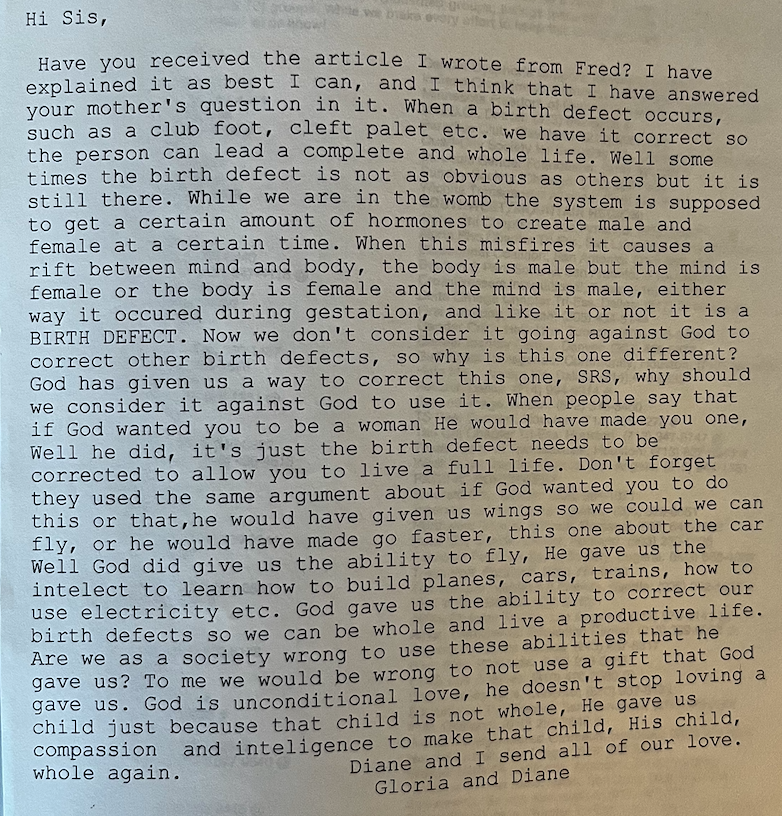
This message-based exchange is reflective of 1990s discourses of trans identity, characterized by underlying ideas of biological and gender essentialism, but the impact of the argument cannot be understated. Gloria and Diane, who may themselves have been trans women, aid Rebecca in debunking an argument that both being trans and seeking gender affirming care go against God by locating “SRS” (sex-reassignment surgery) as a logical extension of medical and technological advancement. The question of what goes against God falls apart if anyone uses most modern advancements, such as planes. It is clear that Gloria and Diane are doing the trans information work of equipping another individual with communal information which they can then share with others. The information affirms transness as a real identity (perhaps even affirming Rebecca’s transness) and attempts to provide information in contrast to religiously-fueled, anti-trans sentiments. Indeed, the second of the two messages extends the discussion, this time from another poster, Carla, who responds to Gloria and Diane, stating:
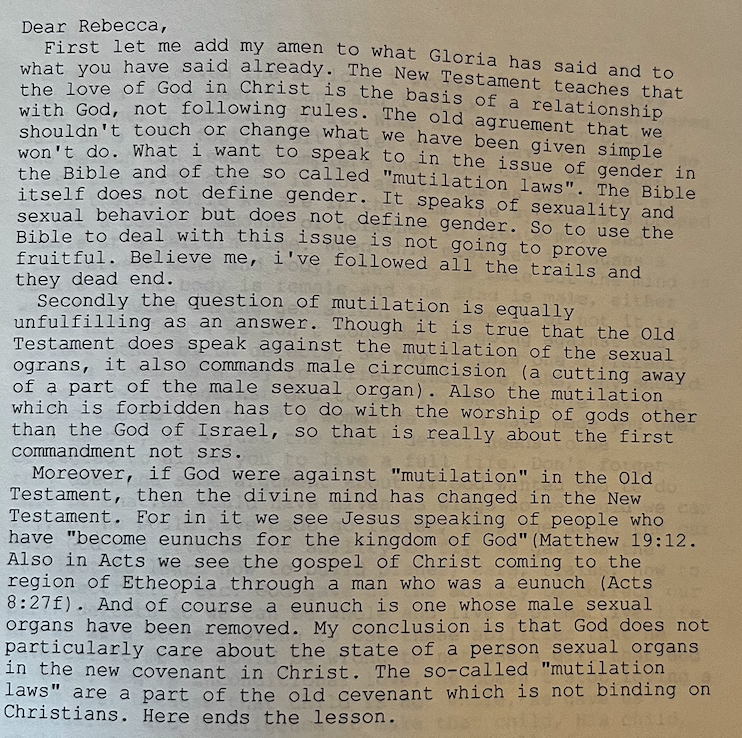
Again, this message seems to respond to an undocumented discussion of finding ways to combat religious (specifically Christian) talking points about transgender identity. Rather than focusing on the realities of scientific advancement, Carla provides a reminder that the Bible is, in fact, quite unclear on how to think through topics of gender and changing one’s body. Elsewhere in the message, Carla acknowledges that the Bible has explicit discussions on the changing of one’s genitalia via circumcision. While this is obviously not a parallel to gender affirming care, it does, in Carla’s mind, provide an informational foil to a person who might use the Bible as an informational resource. I would argue here that Carla, in responding to Rebecca, engages in a form of defensive communal trans information work. Carla’s goal seems to be to aid Rebecca by encouraging them to avoid spending time scouring the Bible for a bit of new information that could change one’s opinion or convincing their mother of the legitimacy of their being transgender or the possibility of transgender existence. Instead, even through the incomplete messages I discovered in the back of the copy of Cross-Talk, this BBS demonstrates how trans information work provided a vital source of affirmation beyond the walls of a person’s home through the affordances of early Internet technologies. In some ways, it also provided a reminder of why I do trans information work in the present.
Re/Learning Trans Information Work
I realize that I am describing a set of communications at the onset and conclusion of this paper that are somewhat dissonant. One is an archival encounter that reveals a moment of hopeful trans information work between individuals in a message board, the other is a bit of communication received by an acquaintance on social media whose intentions remain questionable at best and antagonistic at worst. While I was and still am frustrated with having to justify trans youth to a person on my personal social media, I have to believe it came from a place of well-meaning intentions. That said, I know it is a familiar experience for many who will read this article hoping to understand the “how” of trans information work. The reality is: you are probably already doing trans information work and will continue to do trans information work, even as there exist growing threats to visibly and publicly doing so. Take as an example the two message board posts I discussed; like my own reflection of trans information work which begins this article, these messages were private communication, but even private encounters sometimes make their way into the archival record and become part of our shared history.
When trans information is preserved, one can open a copy of a trans newsletter from decades earlier and find vital evidence of the ongoing need for explicitly affirmative defenses for trans existence. Even if I have to speculate on the exact circumstances of these exchanges, I can use the communication to prove that support for trans people existed, even if that trans information work was happening exclusively between other trans folks. Further, unlike the broader run of Cross-Talk which benefited from sustained creative support, these printed messages reflect the personal and often private and unseen trans information work done on a day-to-day basis. In some ways, it was a sort of social media direct message of the time. The documents do not disclose their age nor, honestly, their gender. However, trans ways of being and knowing vibrate through the documents and now vibrate through me as I reflect on what it means to uplift, affirm, and defend trans existence during a time when the explicit violence of anti-trans legislation wants transness to disappear. Ultimately, the purpose of trans information work is about defending one’s individual ability to both embrace and celebrate trans ways of being, while simultaneously accepting that this celebration can and should serve as a means to invite other trans folks to affirm themselves and others.
If I can find validity in my existence and its legitimacy between two message board posts with scant provenance, how might my own assertions of trans ways of being in a series of social media messages provide similar guideposts for trans folks in the future? The reality is, I can assume these messages will fall to the wayside in the ever-growing deluge of lost digital information. However, I stumbled upon, via analog means, two otherwise-lost documents of trans information work. In this encounter, I was reminded of a vital reality of what it means to do trans information work: to create ways of knowing and being dedicated to myself, as someone who desperately wanted this evidence in my past. It is also about filling in gaps whenever and wherever our capacity allows. We cannot always engage in trans information work, whether it be due to personal limitations or collective safety, but what we are able to do can result in unforeseen positive impacts in the future. Ideally, trans folks would not have to engage with individuals whose intentions may be malicious, but the record of that interaction may be valuable to someone who stumbles upon it in the future. More importantly, however, that record may offer more meaningful visibility of all of the trans information work I do with and for other trans folks, many of whom see me and others as a vital first point of contact in imagining their existence as possible.
For every questionable social media message that confuses me, there are many more emerging trans information professionals who reach out to me about navigating the job market and being openly trans. These conversations are often tough, but they are always hopeful and always affirmative. For every concern about trans children pushed by an adult, there are opportunities to support my colleagues’ and my friends’ children as they question their identity. If not from a purely factual standpoint, then at least to maintain my well-being, I choose to see the positive interactions as qualitatively and quantitatively greater, even if the negative ones do, indeed, occupy my thoughts in more intense ways. My comments, as inelegant as they continue to be, I hope make clear that I am both in support of trans ways of being and myself as a trans person. This inelegance is what makes trans information work a collaborative process, as it requires both wanting to see and be seen by others, even if that discovery happens beyond the life of any specific trans person. Ultimately, trans information work is about not merely existing, but insisting on that existence being known.
Acknowledgments
I would like to thank the entire Editorial Board from Murmurations for their thoughtful and detailed feedback. It is rare to get this kind of consistent, yet affirming, dialogue about a topic such as this and working together has been a joyful experience. In particular, I would like to thank nicholae cline, Keahi Adolpho, and Anastasia Chiu for their constant communication and engagement throughout this process.
References
Adolpho, K. & Krueger, S.G. (2024). Decistifying trans and gender diverse inclusion in library work: A literature review. In the Library with the Lead Pipe. Retrieved from https://www.inthelibrarywiththeleadpipe.org/2024/decistifying/
Allgood, E. M., & Wagner, T. L. (2025). What is Lost in “Restoring Truth and Sanity:” Queer Approaches to Absence, Silence, and Erasure in Archival Description. The Political Librarian, 8(2).
Barnard, T. (1994, November). Tasha’s world by Tasha Barnard. Cross-Talk: The Gender Community’s News & Information Monthly #61 [Newsletter], p. 25.
Bechdel, A. (2006). Fun home: A family tragicomic. Houghton Mifflin.
Berg, M. (2025). Immaterial, Emotional, Undervalued: Interrogating the Subjugation of Trans and Gender Diverse Labour in Libraries. Journal of Radical Librarianship, 11, 207-230.
Broda, E., & Strömbäck, J. (2024). Misinformation, disinformation, and fake news: lessons from an interdisciplinary, systematic literature review. Annals of the International Communication Association, 48(2), 139-166.
Brown, J., cline, n., & Méndez-Brady, M. (2021). Leaning on labour. In Leung, S.Y. & López-McKnight, J.R. (Eds.) Knowledge justice : Disrupting library and information studies through critical race theory, 97-110.
Dan, V., Paris, B., Donovan, J., Hameleers, M., Roozenbeek, J., Van Der Linden, S., & Von Sikorski, C. (2021). Visual mis-and disinformation, social media, and democracy. Journalism & Mass Communication Quarterly, 98(3), 641-664.
Drabinski, E. (2008). Teaching the radical catalog. Radical cataloging: Essays at the front, 198-205.
Ettarh, F. (2018). Vocational awe and librarianship : The lies we tell ourselves. In the Library with the Lead Pipe.
Fink, M., & Miller, Q. (2014). Trans media moments: Tumblr, 2011–2013. Television & New Media, 15(7), 611-626.
Floegel, D., & Costello, K. L. (2021). ” Expanding on the Almost”: Queer World-Building and Institutional Information Worlds. Journal of Critical Library and Information Studies, 3(3).
Gleick, J. (2011). The information: A history, a theory, a flood. Vintage.
Haimson, O. L. (2025). Trans Technologies. MIT Press.
Jenkins, H. (2006). Fans, bloggers, and gamers: Exploring participatory culture. New York University Press.
Judd, R. (1994, November). Great moments in tv history from the archives of Ralph Judd. Cross-Talk: The Gender Community’s News & Information Monthly #61 [Newsletter], p. 24.
Kitzie, V. L., Wagner, T. L., Lookingbill, V., & Vera, N. (2022). Advancing information practices theoretical discourses centered on marginality, community, and embodiment: Learning from the experiences of lesbian, gay, bisexual, transgender, queer, intersex, and asexual (LGBTQIA+) communities. Journal of the Association for Information Science and Technology, 73(4), 494-510.
Krueger, S.G. (2019). Supporting trans people in libraries. Libraries Unlimited.
Latham, J. M., & Cooke, S. (2020). (Im) patient Narratives: Peer-to-Peer Health Information Transfer in the LGBTQ+ Community via Zines from the Queer Zine Archive Project (QZAP). In Roles and Responsibilities of Libraries in Increasing Consumer Health Literacy and Reducing Health Disparities (Vol. 47, pp. 241-261). Emerald Publishing Limited.
Mattern, S. (2014). Library as infrastructure. Places Journal. Retrieved from https://placesjournal.org/article/library-as-infrastructure/
Radford, G. P., Radford, M. L., & Lingel, J. (2015). The library as heterotopia: Michel Foucault and the experience of library space. Journal of Documentation, 71(4), 733-751.
Simon, M. (2016). Collective reading and communities of practice: Teaching Alison Bechdel’s Fun Home. Transformations, 26(2), 139-156.
Spade, D. (2015). Normal life: Administrative violence, critical trans politics, and the limits of law. Duke University Press.
Spiel, K. (2021, June). ” Why are they all obsessed with Gender?”—(Non) binary Navigations through Technological Infrastructures. In Proceedings of the 2021 ACM Designing Interactive Systems Conference (pp. 478-494).
Threats, M. (2025). Toward information resilience: Applying intersectionality to the HIV/AIDS information practices of Black sexual minority men. Journal of the Association for Information Science and Technology, 76(8), 1123-1140.
Wagner, T. L., Allgood, E. M., & Caballero, M. (2025). “The finding aid is the first thing that people see, we don’t want to put anyone off viewing the collection”: how practitioners navigate queerness in finding aids. Archival Science, 25(4), 43.
Wagner, T. L., Kitzie, V. L., & Lookingbill, V. (2022). Transgender and nonbinary individuals and ICT-driven information practices in response to transexclusionary healthcare systems: a qualitative study. Journal of the American Medical Informatics Association, 29(2), 239-248.
Wagner, T. L., & Crowley, A. (2020). Why are bathrooms inclusive if the stacks exclude? Systemic exclusion of trans and gender nonconforming persons in post-Trump academic librarianship. Reference Services Review, 48(1), 159-181.
Wagner, T. L., & Blewer, A. (2019). “The word real is no longer real”: Deepfakes, gender, and the challenges of AI-altered video. Open Information Science, 3(1), 32-46.
Walworth, J. (1994, November). Michigan Womyn’s Festival 1994 : Transsexual protesters allowed to enter. Cross-Talk: The Gender Community’s News & Information Monthly #61 [Newsletter], p. 27-29.
Watson, B. M., Murphy, D., Schaefer, B., & Huang, J. (2023). “Our metadata, ourselves”: the trans metadata collective. Proceedings of the Association for Information Science and Technology, 60(1), 433-441.
Weiser, S. G., Wagner, T. L., & Lawter, M. (2018). Double jeopardy:(Trans) versing higher ed as queer trans advocates. Journal of Curriculum and Pedagogy, 15(3), 323-339.
Wolfe, D., & Paterson, S. I. A. (2026). Decolonizing Anatomy: Examining and Unpicking the Relationship Between Coloniality, Sex, Gender, and the Body. In Decolonial Perspectives in Biomedical Sciences, Anatomical Education and Healthcare: Advancing Equity and Global Perspectives(pp. 35-73). Cham: Springer Nature Switzerland.


Leave a comment